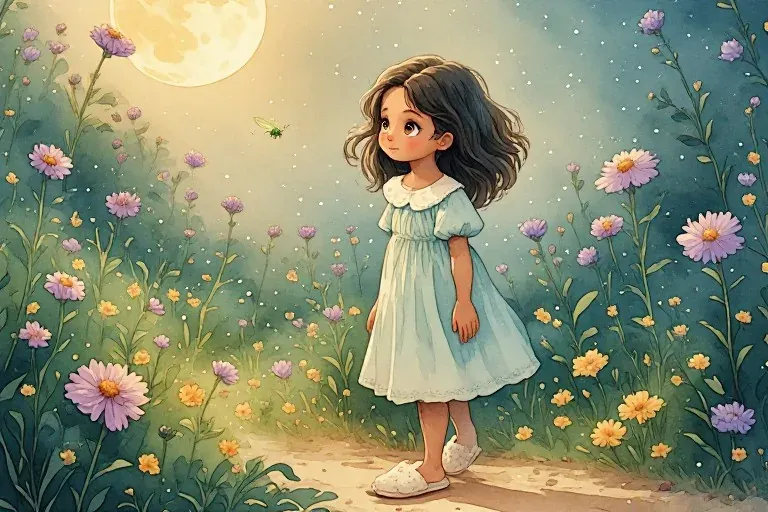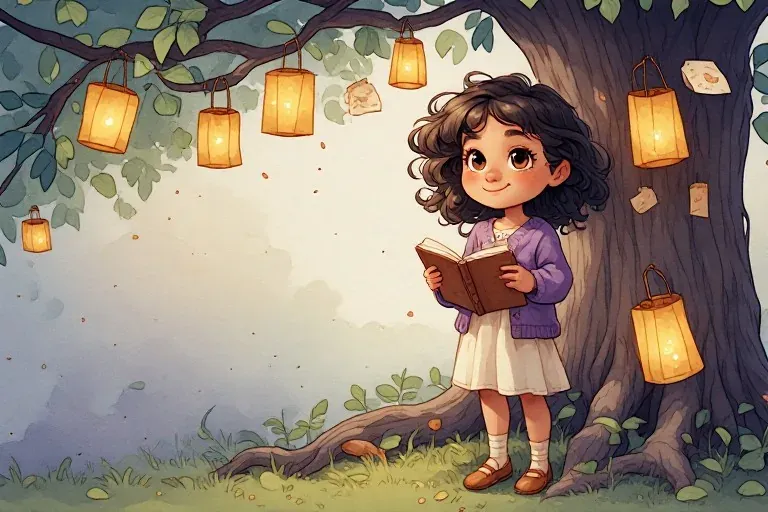
In Nia’s village, people tied paper wishes to the old willow at midsummer. Nia wished that her grandmother could visit for the lantern walk.
Grandmother lived beyond the hills. Her ankle was sore, and the path was steep.
Nia checked the willow every morning. Her paper moved in the breeze, but no carriage came down the road.
‘Does the tree need more time?’ she asked her father.
‘A wish can help us understand what matters,’ he said. ‘Then we can think about what to do.’
Nia sat beneath the branches with her drawing book. She drew the lanterns, the bridge, and the bench where Grandmother liked to rest.
Then she had an idea.
If Grandmother could not come to the walk, part of the walk could come to her.
Nia and her father made three paper lanterns. They used small battery lights, so the paper stayed cool. They packed Nia’s drawings and a pot of soup. Her father arranged a ride over the hills.
Grandmother opened her door to find Nia and her father holding three little lanterns.
Nia put the lights around the sitting room. She showed each drawing and described the places along the village path.
‘And here,’ she said, pointing to the last page, ‘is where we sit together.’
Grandmother pulled a chair close.
When Nia returned home, her paper was still on the willow. The tree had not brought a carriage. Her wish had not happened exactly as she imagined.
She untied the paper and tucked it into her drawing book.
Beside it she drew three lanterns, a bowl of soup, and Grandmother’s hand resting over hers.